

Wondering how does a hot water heater work? Understanding your system is the first step to keeping it running efficiently. A reliable water heater is essential in any Columbia home, from Shandon’s historic bungalows to modern Northeast builds. But have you ever wondered how it works?
Your system provides hot showers, clean dishes, and more, but understanding gas, electric, and tankless models can help you:
- Maintain efficiency
- Extend lifespan
- Choose the right replacement
This guide covers key components, water heater types, and how they function.
Basic Components of a Water Heater
No matter the type, all water heaters share key components that work together to heat and distribute water efficiently.
- Storage Tank: A large, insulated container that holds heated water until needed. Most residential tanks range from 30 to 80 gallons.
- Heating Element or Burner: Electric water heaters use heating coils, while gas models use a burner to warm the water.
- Thermostat: Regulates the water temperature, typically set between 120–140°F for safety and efficiency.
- Pressure Relief Valve: A crucial safety feature that prevents excessive pressure buildup inside the tank.
- Dip Tube & Heat-Out Pipe: The dip tube sends cold water to the tank’s bottom, while the heat-out pipe delivers hot water.
- Corroded pipes in older homes like Elmwood Park and Earlewood can restrict flow and reduce efficiency.
- Regular flushing or pipe replacements keep systems running smoothly.
How Gas Water Heaters Work
Gas water heaters are popular in Columbia, primarily where Dominion Energy provides natural gas. They heat water quickly using combustion.
- A gas burner ignites, producing heat that warms the water in the storage tank.
- The thermostat monitors water temperature, turning the burner on and off as needed.
- A flue pipe safely vents exhaust gases outdoors.
How Altitude and Climate Affects Gas Water Heaters
Columbia’s low elevation doesn’t significantly impact gas water heaters like in high-altitude areas. However, the city’s hot summers and mild winters still affect your system's operation.
- Hot summers can increase the demand for cool water, meaning your heater may run less frequently, reducing energy use.
- Water heaters work harder during cold snaps, increasing energy use and wear.
- Older units or poorly insulated tanks may struggle to keep up, leading to longer wait times for hot water.
A simple fix is to insulate your water heater. A blanket can help retain heat, reduce energy waste, and keep your water heater system running efficiently all winter.
How Electric Water Heaters Work
Electric water heaters are a popular alternative for homes without natural gas service. These units rely on two heating elements—one near the top and one near the bottom of the tank.
- The upper and lower heating elements activate separately, ensuring an even heat distribution.
- Thermostats control each element, alternating as necessary to maintain a consistent temperature.
How Tankless Water Heaters Work
Tankless water heaters, which heat water on demand instead of storing it, are popular in space-conscious homes like Shandon and Elmwood Park.
- Flow sensors detect when a hot water tap is turned on, activating the heating coils or gas burner.
- Water is heated instantly as it moves through the system.
- Recirculation systems can be added to reduce hot water wait times, especially in larger homes.
One drawback of tankless models is their limited simultaneous use—multiple people using hot water at once may cause a drop in pressure.
Water Heating Process (Step-by-Step Flow)
All water heaters follow a similar process to ensure a steady hot water supply when needed. Here’s how it works.
1. Cold Water Enters Through the Dip Tube
When you turn on a hot tap, cold water enters through the dip tube, directing it to the tank’s bottom for efficient heating.
- In gas water heaters, the burner at the unit's base begins heating the water.
- In electric models, heating elements inside the tank warm the water.
- For tankless systems, water enters a heat exchanger, where it is rapidly warmed as it flows through.
2. Heating Element or Burner Warms the Water
Once inside, the water is heated to the temperature set on your thermostat (usually between 120–140°F).
- In gas heaters, the burner ignites, generating heat that warms the tank's water. A flue pipe safely vents combustion gases.
- In electric models, one or two heating elements (typically located at the top and bottom of the tank) warm the water.
- In tankless units, powerful gas burners or electric heating coils rapidly heat the water as it moves through the system.
This process continues automatically until the water reaches the preset temperature.
3. Hot Water Rises to the Top of the Tank or Flows Through the Unit
Once heated, hot water naturally rises to the top of the storage tank. Since hot water is less dense than cold water, it remains at the upper section of the heater, ready for use.
- In traditional storage tank heaters, this heated water stays in the tank until needed.
- In tankless systems, there is no storage—water is heated instantly and flows directly to your tap when you turn it on.
4. Heat-Out Pipe Delivers Hot Water to Your Home
Finally, when you open a hot water tap, heated water exits through the heat-out pipe at the top of the tank. From there, it travels through your plumbing system to supply:
- Showers and bathtubs
- Kitchen and bathroom sinks
- Dishwashers and washing machines
The cycle repeats as you use hot water, with fresh cold water entering the tank or heat exchanger to provide a continuous supply.
Knowing this process helps homeowners spot hot water heater problems and boost efficiency.
Regular maintenance, insulation, and flushing the tank can extend the lifespan of your unit and keep your hot water running smoothly. If you find yourself in need of hot water heater service, Cassell Bros' trusted plumbing team has you covered on everything from tankless water heater repair to getting you a quote for water heater replacement.
A clogged or slow-moving drain can quickly become a frustrating household issue. Whether it's a smelly sink, a sluggish shower drain, or a backed-up toilet, taking proactive steps to clean and maintain your drains can help prevent plumbing emergencies.
While some drain unblocking can be tackled with simple do-it-yourself solutions, it's important to understand that different drains require different approaches. If home remedies don’t work, calling a professional drain cleaning service in Columbia, SC, may be the best solution.
Below, we’ll cover effective DIY drain cleaning solutions for sinks, showers, and toilets, along with when to call a plumber for expert help.
How to Clean Your Smelly Sink Drain
Your kitchen sink is one of the hardest-working drains in your home, and food particles, grease, and soap residue can cause buildup over time. If your sink drain starts to emit unpleasant odors, follow these steps to freshen it up:
Preventative Tips
- Avoid pouring grease, coffee grounds, and food scraps down the drain.
- Run hot water after using the sink to help flush away debris.
- Regularly clean the drain with a mixture of baking soda and vinegar.
DIY Drain Cleaner Instructions
- Boiling Water Method: Pour a kettle of boiling water down the drain to dissolve grease and loosen minor clogs.
- Baking Soda & Vinegar: Pour ½ cup of baking soda down the drain, followed by ½ cup of vinegar. Let it fizz for about 15 minutes, then rinse with hot water.
- Lemon & Ice Cube Trick: If your sink has a garbage disposal, drop in some ice cubes and a few lemon peels. Run the disposal to help eliminate odors and sharpen the blades.
If your sink remains clogged or continues to smell bad, you may need professional drain cleaning. Cassell offers expert solutions to remove deep clogs and prevent future drain clogs.
How to Clean a Stinky Shower Drain
Soap scum, hair, and dirt buildup can lead to slow-draining and foul-smelling showers. A clogged shower drain can quickly turn into standing water issues, so maintaining a clean and free-flowing system is crucial.
Preventative Tips
- Use a drain cover to catch hair and debris.
- Flush the drain with hot water once a week to minimize buildup.
- Avoid washing excess oils and lotions down the drain, as they contribute to blockages.
DIY Drain Cleaner Instructions
- Remove Debris: If water drains slowly, remove the drain cover and use a wire hanger or drain snake to remove hair and buildup.
- Baking Soda & Vinegar Solution: Pour ½ cup of baking soda into the drain, followed by ½ cup of vinegar. Wait 15 minutes, then flush with hot water.
- Use a Plunger: If the clog is persistent, try using a plunger with firm, repetitive motions to dislodge the blockage.
Clogged Toilet Repair and Cleaning
Few household plumbing issues are as urgent as a clogged toilet. While a plunger is often the go-to tool, some blockages require extra effort to clear.
Preventative Tips
- Only flush toilet paper and waste. Do not flush wipes, paper towels, or hygiene products.
- Keep a small wastebasket in the bathroom to prevent accidental flushing of non-flushable items.
- Regularly clean the toilet to prevent buildup inside the drain.
DIY Drain Cleaner Instructions
- Plunge Correctly: Use a high-quality plunger with a flange. Ensure a tight seal around the drain and use firm, forceful plunges.
- Hot Water & Dish Soap: Pour a small amount of dish soap into the bowl, followed by a bucket of hot water. The soap can help break down the clog.
- Use a Toilet Auger: If plunging doesn’t work, a toilet auger (also known as a closet auger) can reach deeper into the drain to break up blockages.
If none of these methods work, your plumbing system may have a more serious obstruction.
Drain Cleaning Plumbing Services in Columbia, SC
While DIY drain cleaning methods can help with minor clogs and odors, some plumbing issues require professional expertise. If you’re experiencing persistent clogs, slow drainage, or foul odors that won’t go away, it may be time to call a drain cleaning specialist. Cassell Brothers is available for 7 Days a Week Emergency Plumbing Repairs in South Carolina.
At Cassell, we provide expert drain cleaning services to help SC Midlands homeowners maintain healthy and efficient plumbing systems. Our team uses advanced tools such as hydro jetting, drain snaking, and now even plumbing camera inspections to remove blockages safely and effectively.
Why Choose Cassell for Drain Cleaning?
- Experienced and licensed plumbers
- Advanced drain cleaning technology
- Safe and eco-friendly cleaning methods
- Fast and reliable service in Columbia, SC
If you need professional drain cleaning or suspect a severe clog, don’t hesitate to contact Cassell today. We’re here to keep your plumbing system in top shape.
Updated: July 2026
If your furnace won't start after a power outage or keeps shutting off, and your model has a reset button, you may need to reset it. A furnace reset often restores normal operation after a temporary issue, but if the reset button trips repeatedly, it could indicate an overheating furnace, restricted airflow, or another problem that requires professional furnace repair. During the colder months in Columbia, Lexington, Irmo, Chapin, and throughout the South Carolina Midlands, knowing when and how to safely reset your furnace can help restore heat while preventing further damage.
Most furnaces are equipped with a reset feature that automatically shuts the system down when it detects a potentially unsafe condition. This safety mechanism helps protect your furnace from damage and can prevent more serious problems from developing. While a single reset after a power interruption is often normal, repeated resets are a sign that your heating system should be inspected by a professional.
In this guide, we'll explain when you should reset your furnace, how to reset different types of furnaces safely, why the reset button keeps tripping, and when it's time to schedule furnace repair.
In This Article
- When Should You Reset a Furnace?
- Where Is the Furnace Reset Button?
- How to Reset Your Furnace
- Why Does My Furnace Keep Tripping the Reset Button?
- Furnace Reset Not Working? When to Call a Professional
- Furnace Repair in Columbia, SC: Why Homeowners Trust Cassell Brothers
When Should You Reset a Furnace?
A furnace reset is meant for temporary, one-time issues - not as a repeated fix for a furnace that won't stay on. You should only reset your furnace after:
- A power outage or electrical surge - the furnace loses power and needs a manual restart once power returns.
- A temporary fault, like a brief airflow restriction from a closed vent that's since been reopened.
- A safety switch trip after the underlying issue (like an overheated blower) has already cooled down or been resolved.
- Your owner's manual specifically recommends it for your model.
In each of these cases, the reset should work on the first try. If it doesn't hold, that's your signal the problem isn't temporary.
Important: Only press the reset button once. If your furnace shuts down again after resetting, stop using the system and schedule professional furnace repair. Repeated resets can damage components and may indicate a more serious safety issue.
Where Is the Furnace Reset Button?
Not every furnace has a manual reset button, and its location varies by manufacturer and model. On many furnaces, the reset button is located inside the blower compartment or near the blower motor. Some gas furnaces place it near the burner assembly, while electric furnaces often locate it closer to the blower motor. If you can't find the reset button, consult your owner's manual before attempting to reset the system.
6 Simple Steps to Reset Your Furnace
Most furnaces follow the same basic reset process, but the exact steps can vary depending on your system. Use the overview below as a quick reference, then refer to your owner's manual for any model-specific instructions.
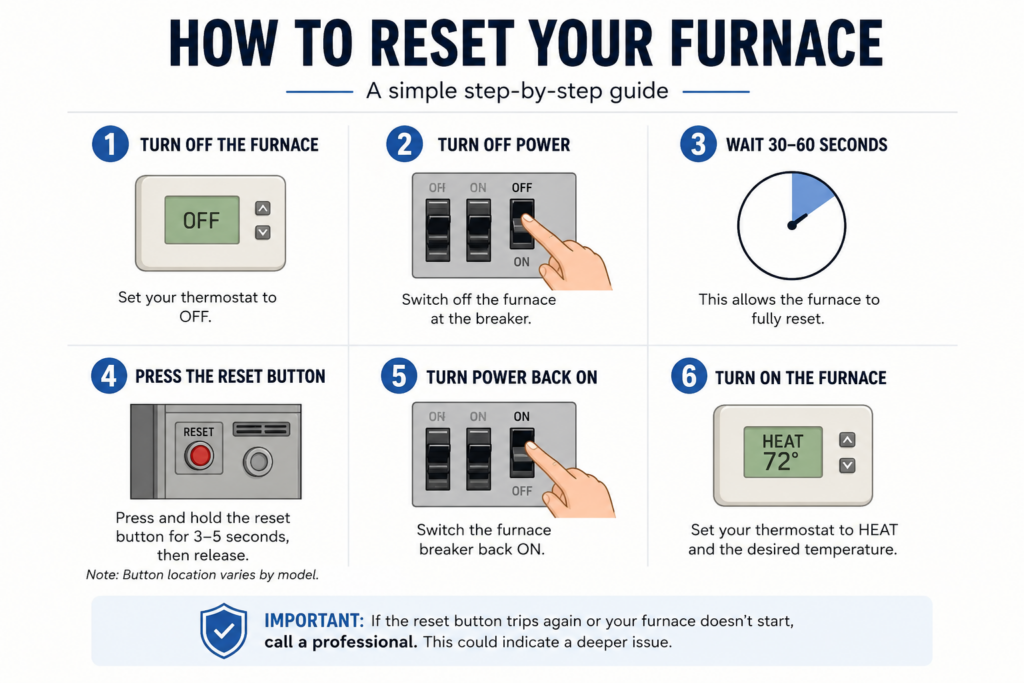
General furnace reset process. Button locations and reset procedures may vary by manufacturer and model.
Why Does My Furnace Keep Tripping the Reset Button?
If you're resetting your furnace more than once, something's causing the trip — and it's worth knowing what before you call for service:
- Dirty air filter - Restricted airflow is one of the most common causes of furnace overheating.
- Blocked supply or return vents - Closed or obstructed vents reduce airflow and can trigger the safety switch.
- Dirty or faulty flame sensor - A dirty sensor may fail to detect the burner flame, causing the furnace to shut down.
- Faulty thermostat - Incorrect temperature readings can cause short cycling or improper operation.
- Tripped circuit breaker or electrical issue - Power interruptions may prevent the furnace from operating normally.
- Clogged fuel line (oil furnaces) - Restricted fuel flow can prevent proper ignition.
- Closed gas valve (gas furnaces) - A partially or fully closed valve prevents the burner from receiving fuel.
- Blower motor problems - If the blower can't move enough air, the furnace may overheat and trip the reset switch.
If replacing the air filter, opening blocked vents, or restoring power doesn't solve the problem, schedule professional furnace repair to prevent additional damage.

Furnace Reset Not Working? When to Call a Professional for Assistance
| Symptom | Likely Cause | Recommended Action |
|---|---|---|
| Reset button didn't restore heat | Mechanical or electrical fault | Call a professional |
| Furnace needs frequent resets | Dirty air filter, overheating, or airflow restriction | Replace the filter first. If the problem continues, schedule service. |
| Error codes continue after resetting | Sensor or component failure | Call a professional |
| Banging, grinding, or squealing noises | Internal mechanical issue | Turn the furnace off and call a professional. |
| Gas smell or suspected leak | Potential gas leak | Leave the home immediately and contact your gas utility and an HVAC professional. |
Though your furnace's reset feature is designed for ease of use, there may be times when the results aren't what the average homeowner might be equipped to handle. In those cases, it's best to call a qualified, knowledgeable furnace service provider for help. Instances where you might need furnace service include:
- The reset didn't work
- Frequent resets are needed
- Error codes continue
- Strange noises coming from your furnace
- If you have any safety concerns (such as gases leaking)
Expert Furnace Repair in Columbia: Why Homeowners Trust Cassell Brothers
If your furnace won't restart after a reset or the reset button continues tripping, don't ignore the warning signs. Continuing to reset the system can lead to additional damage and may create a safety hazard.
Cassell Brothers provides professional furnace repair throughout Columbia, Lexington, Irmo, Chapin, and the surrounding South Carolina Midlands. Our licensed technicians can quickly diagnose the underlying problem, restore safe operation, and help prevent future breakdowns.
Since 2008, our family-owned and operated company has delivered trusted heating services backed by more than 60 years of combined experience. We offer emergency furnace repair, licensed and insured technicians, and a 100% satisfaction guarantee so you can feel confident your heating system is in good hands.
To learn more about furnace services from Cassell Brothers Home Services in the Midlands area of South Carolina, call (803) 868-6191 or fill out a contact form online, and we'll be with you shortly!
If you are having a water heater installed in your home for the first time, one of the first decisions you must make is whether it will be gas or electric. Since both are available for most sizes, the decision most often comes down to what connections you have available and their relative cost.
To learn more about which type of water heater in will be most effective and cost efficient for your home, call Cassell Brothers today. One of our technicians can discuss your options with you and provide the water heater installation services needed for your new electric or gas water heater in .
Schedule OnlineGas Water Heaters
Gas water heaters require a gas line to operate so if your home does not have natural gas connections, then this will not be an option. However, if you do have natural gas, a gas water heater may be a good fit for your needs.
Gas water heaters have a pilot light that ignites a burner plate beneath the tank whenever the temperature of the water in the tank drops below the thermostat setting. Most modern gas water heaters have electronic ignition to ensure only as much gas as is needed is used for your system. Because a gas water heater burns gas, it requires an exhaust system as well. This means it needs to be patched into the chimney or a separate ventilation system. This can add to the installation cost if you do not currently have a gas appliance in your utility room.
Electric Water Heaters
Whereas gas water heaters use a burner plate, electric water heaters use electrical elements to heat the water. Like the gas water heater, an electrical model will turn on when the temperature drops below the thermostat setting. The elements will turn on and start to heat the water.
Because you don’t need to connect an electric water heater to a gas line or exhaust system, installation is less expensive and can usually be completed relatively fast. Additionally, you can install insulation upgrades like a water heater blanket that will reduce heat loss from the tank without worrying about the gas burners.
The trade-off of easier and less expensive installation is that an electric water heater is often more expensive to operate. In The Midlands and the surrounding area, electricity is more expensive than natural gas and will likely remain that way for some time. So, you will pay more to operate your water heater if it is electric.
Ultimately, the decision on what type of water heater is best for your home depends on the size of your home, the relative cost of installation and what you currently have installed. If you only need a small water heater for a basement apartment, electrical might be your best option, whereas a full–sized gas water heater may be better for your entire home.
Call the Electric and Gas Water Heater Installation Experts
Whatever you decide, know that Cassell Brothers Home Services’s plumbing team is available to provide installation services for your gas or electric water heater in The Midlands. Call us today to learn more about what we can do for you.